What Is Self-Employment Tax? How to Calculate It and What You Can Deduct
One of the first financial surprises new freelancers encounter is the self-employment tax. When you were an employee, your employer quietly paid half of your Social Security and Medicare taxes on your behalf. As a self-employed individual in the United States, you are responsible for the entire amount. Understanding how this tax works, how to calculate it, and how to reduce your bill legally is one of the most important things you can do for your financial health as a freelancer.
What Is Self-Employment Tax?
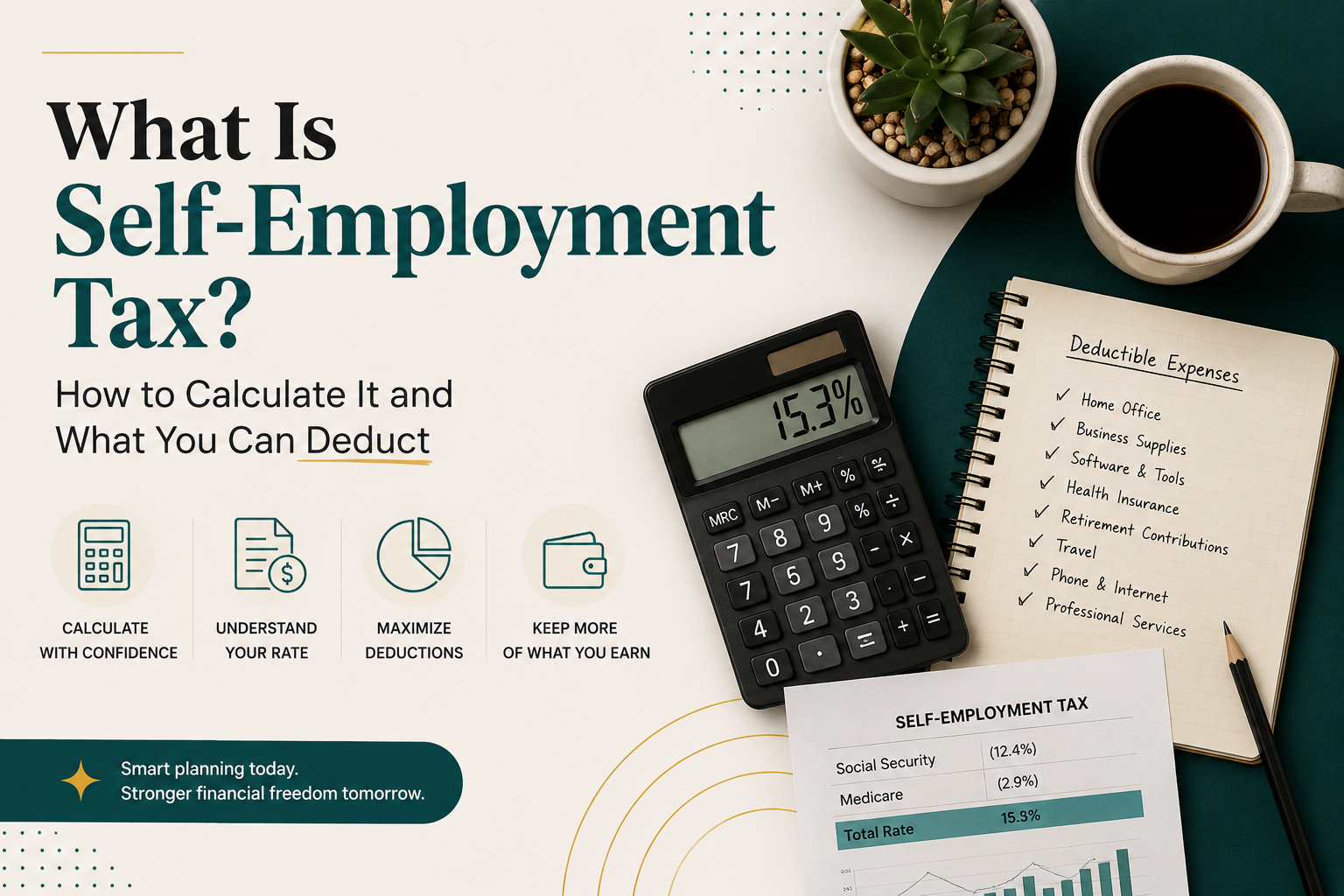
Self-employment (SE) tax is the mechanism through which self-employed Americans contribute to Social Security and Medicare. When you work for an employer, the total contribution is 15.3 percent of your wages — 12.4 percent for Social Security and 2.9 percent for Medicare. Your employer pays half (7.65 percent) and the other half is withheld from your paycheck.
When you are self-employed, you pay both halves. The full 15.3 percent comes out of your net self-employment income. This is separate from and in addition to federal and state income taxes.
The Self-Employment Tax Rate in 2026
For 2026, the self-employment tax rate is 15.3 percent on the first $168,600 of net self-employment income. Above that threshold, only the 2.9 percent Medicare portion applies. High earners — those with income over $200,000 if single or $250,000 if married filing jointly — also pay an additional 0.9 percent Medicare surtax.
How to Calculate Your Self-Employment Tax
The calculation has two steps. First, multiply your net self-employment income by 92.35 percent. This adjustment accounts for the fact that employees only pay tax on their wages, not on the employer portion. Then multiply the result by 15.3 percent.
Example: If your net freelance income is $80,000, you multiply $80,000 by 0.9235 to get $73,880. Then multiply $73,880 by 0.153 to get approximately $11,304 in self-employment tax.
The Deductible Half of Self-Employment Tax
Here is the good news: the IRS allows you to deduct half of your self-employment tax from your gross income when calculating your income tax. In the example above, you could deduct approximately $5,652 from your taxable income. This does not reduce your SE tax bill, but it reduces the income tax you pay on top of it.
Net Self-Employment Income: What Counts
Your net self-employment income is your gross freelance revenue minus your allowable business deductions. This is why tracking every legitimate business expense matters so much. Every dollar you deduct reduces your net SE income and therefore your self-employment tax bill.
→ Best Tax Deductions for Freelancers and Independent Contractors
Quarterly Estimated Taxes and Self-Employment Tax
Self-employment tax is factored into your quarterly estimated tax payments. When you calculate how much to pay each quarter, you are estimating your total federal tax liability for the year, which includes both income tax and self-employment tax. Most freelancers use the prior year safe harbor method to avoid underpayment penalties.
→ How to Pay Quarterly Taxes as a Freelancer in the US
Strategies to Reduce Your Self-Employment Tax
Maximize Your Business Deductions
Every legitimate business expense you deduct reduces your net self-employment income, which directly reduces your SE tax. Common deductions include home office expenses, equipment, software subscriptions, professional development, business travel, and health insurance premiums.
Contribute to a Retirement Account
Contributions to a SEP-IRA or Solo 401(k) reduce your adjusted gross income, which indirectly reduces the income tax portion of your bill. However, they do not reduce your self-employment tax base because SE tax is calculated before retirement contributions are applied.
→ Best Retirement Plans for Self-Employed Americans
Consider an S-Corporation Election
At higher income levels — typically above $50,000 to $60,000 in net profit — some freelancers convert their LLC to be taxed as an S-Corporation. In this structure, you pay yourself a reasonable salary and take the rest as distributions. SE tax only applies to the salary portion, not the distributions. This strategy can save thousands of dollars annually but comes with additional administrative complexity.
Keeping Records for Self-Employment Tax
Accurate record keeping is essential. You need to track all income and all business expenses throughout the year. Using dedicated accounting software makes this dramatically easier and reduces errors at tax time.
→ Best Accounting Software for Freelancers 2026
Summary
Self-employment tax is a significant cost of being your own boss, but it is manageable with good planning. Understand the rate, calculate your estimated payments correctly, maximize your deductions, and consider advanced strategies as your income grows.
→ Complete Freelance Finance Guide → How to Pay Quarterly Taxes as a Freelancer