How to Pay Quarterly Taxes as a Freelancer in the US: Dates, Calculations, and Penalties
Quarterly estimated taxes are one of the most confusing — and most important — financial obligations for freelancers and independent contractors in the United States. Unlike employees who have taxes withheld automatically from each paycheck, self-employed workers must calculate and send tax payments to the IRS four times a year. Miss these deadlines or underpay and the IRS will charge you interest and penalties, even if you pay everything you owe by April 15.
This guide walks you through exactly how to calculate your quarterly payments, when to send them, and how to avoid the most common mistakes.
Who Needs to Pay Quarterly Estimated Taxes?
You are required to make quarterly estimated tax payments if you expect to owe at least $1,000 in federal taxes for the year and your withholding and credits will not cover at least 90 percent of your current year tax liability or 100 percent of your prior year tax liability.
For most freelancers who earn their primary income through self-employment, quarterly estimated taxes are mandatory from the first year they start earning significant income.
The 2026 Quarterly Tax Due Dates
The IRS quarterly tax payment schedule for 2026 is as follows:
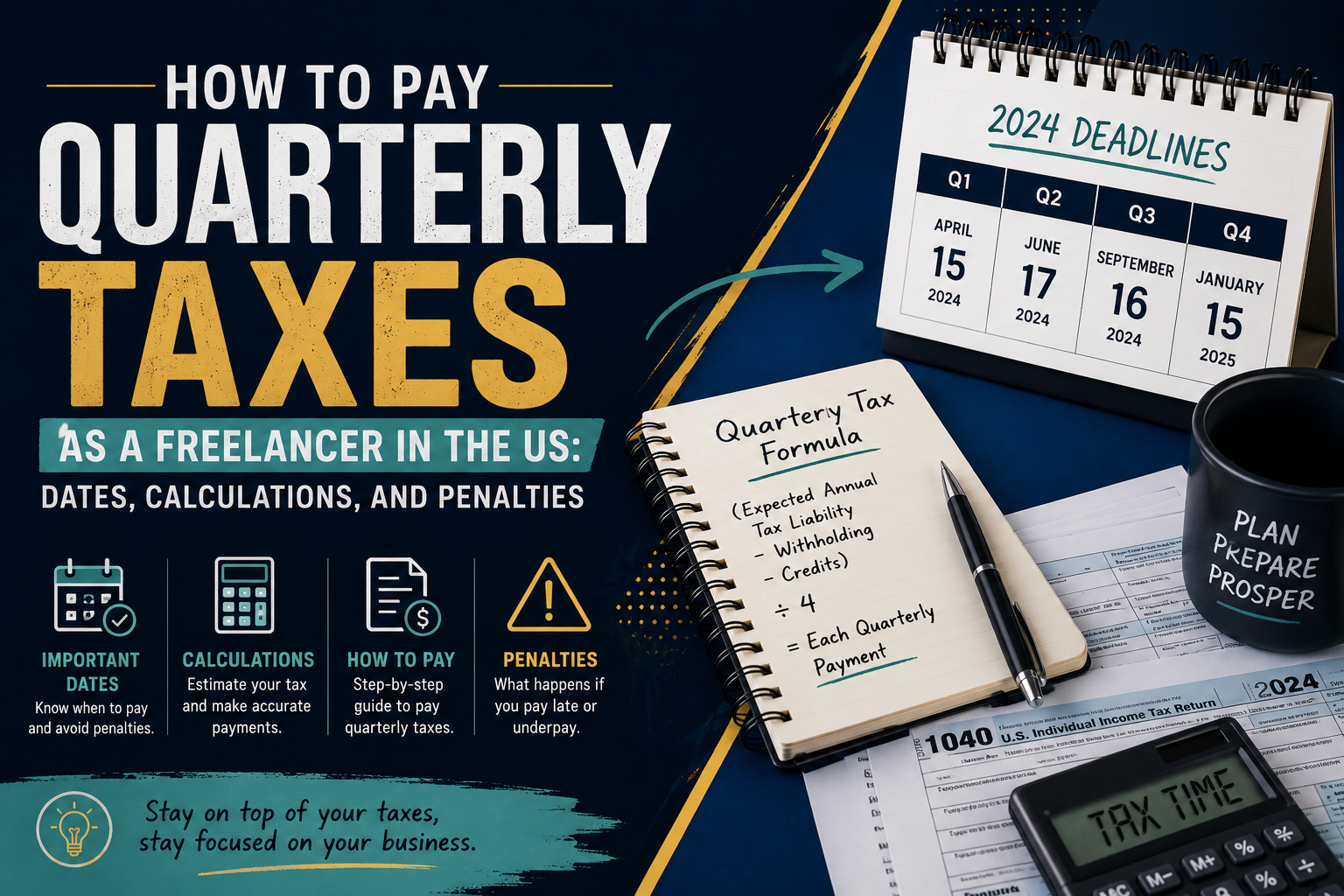
- Q1 (January 1 – March 31): Payment due April 15, 2026
- Q2 (April 1 – May 31): Payment due June 16, 2026
- Q3 (June 1 – August 31): Payment due September 15, 2026
- Q4 (September 1 – December 31): Payment due January 15, 2027
Note that Q2 is shorter than the other quarters. If a deadline falls on a weekend or federal holiday, the due date moves to the next business day.
How to Calculate Your Quarterly Payments
Method 1: The Safe Harbor Method (Recommended for Most Freelancers)
The safest and simplest approach is the prior year safe harbor method. If you pay at least 100 percent of your prior year total tax liability in equal installments across the four quarters, the IRS will not charge you an underpayment penalty regardless of what you actually owe when you file.
If your prior year adjusted gross income was over $150,000, you need to pay 110 percent of your prior year tax liability to qualify for the safe harbor.
Example: Your total federal tax for 2025 was $12,000. To use the safe harbor for 2026, you divide $12,000 by 4 and pay $3,000 each quarter.
Method 2: Estimate Your Current Year Liability
If your income has changed significantly from the prior year, you may want to estimate your actual 2026 tax liability instead. Use IRS Form 1040-ES to project your income, deductions, and credits for the year. Divide the estimated total tax by 4 and pay that amount each quarter. Adjust your payments up or down as your income changes throughout the year.
What to Include in Your Estimated Tax Calculation
Your quarterly estimated payment must cover two things: your federal income tax and your self-employment tax. Many new freelancers forget to include the self-employment tax component and end up significantly underpaying.
→ What Is Self-Employment Tax? How to Calculate It
How to Make Your Quarterly Tax Payments
The IRS offers several ways to pay:
- IRS Direct Pay at irs.gov/directpay — free, no registration required, pays directly from your bank account
- Electronic Federal Tax Payment System (EFTPS) — free, requires registration, allows scheduling future payments
- IRS2Go mobile app
- Check or money order made payable to U.S. Treasury, mailed with Form 1040-ES voucher
Most freelancers prefer EFTPS because it allows you to schedule all four payments at the start of the year and forget about them.
State Quarterly Estimated Taxes
Do not forget that most states with income tax also require quarterly estimated payments. The deadlines generally follow the federal schedule but vary by state. California, New York, Texas, and Florida each have different rules. Check your state tax authority website for specific requirements.
What Happens If You Miss a Payment?
If you miss a quarterly payment or underpay, the IRS charges an underpayment penalty. For 2026, the penalty rate is calculated based on the federal short-term interest rate plus 3 percentage points. The penalty accrues from the due date of each quarter, not from April 15.
The IRS calculates this penalty automatically on Form 2210 when you file your annual return. In many cases the penalty is modest, but it adds up if you miss multiple quarters.
How to Avoid Underpayment Penalties
The most reliable strategies are using the safe harbor method described above, paying via EFTPS so you have a record of each payment, and reviewing your income and adjusting payments every quarter rather than setting and forgetting.
Recommended Tax Software for Quarterly Payments
Using dedicated tax software dramatically simplifies the quarterly estimation process. Most modern platforms will calculate your recommended payment based on your income so far and remind you of upcoming deadlines.
→ Best Tax Software for Self-Employed Americans 2026 → Best Tax Deductions for Freelancers → Complete Freelance Finance Guide