
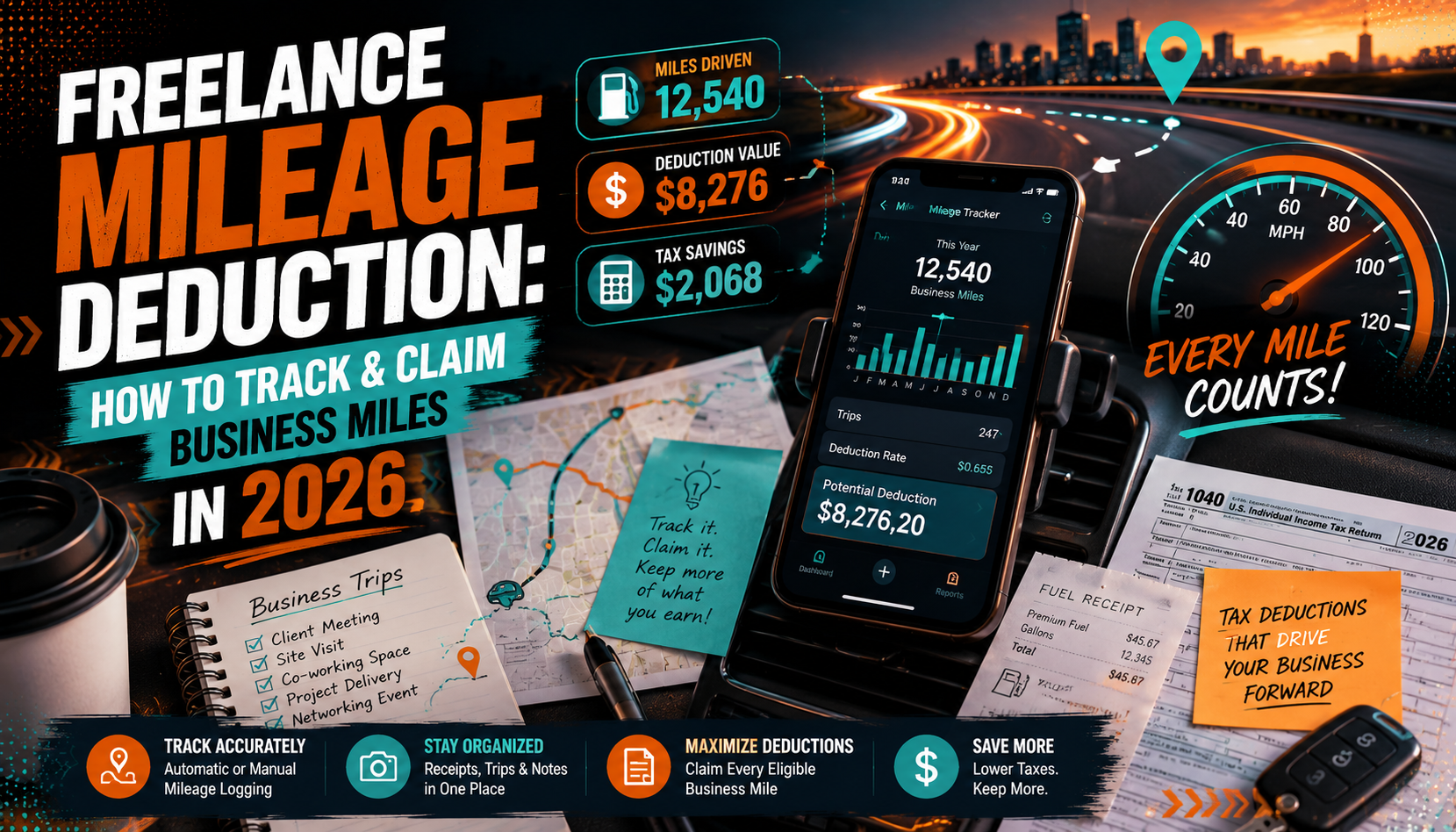
Freelance Mileage Deduction: How to Track and Claim Business Miles in 2026
If you use your personal vehicle for business purposes as a freelancer, you may be entitled to a significant tax deduction. The IRS allows self-employed individuals to deduct the cost of business-related driving either at the standard mileage rate or based on actual vehicle expenses. For many freelancers, mileage is one of the most overlooked deductions available.
What Counts as Business Mileage for Freelancers?
Business mileage includes any driving directly related to your work, such as:
- Driving to a client’s office or job site
- Traveling to a business meeting, conference, or networking event
- Driving to the bank to make business deposits
- Traveling to a post office or shipping center for business packages
- Driving to pick up business supplies
What does not count: your commute from home to a regular fixed place of work. However, if your home is your principal place of business (which qualifies you for the home office deduction), then most business-related driving from home qualifies.
→ Tax Write-Offs for Home Office Freelancers
The Standard Mileage Rate for 2026
The IRS publishes the standard mileage rate annually. For 2025 it was 67 cents per mile for business driving. The 2026 rate is expected to be published in January 2026 — check the IRS website for the official rate. To calculate your deduction, multiply your total business miles by the standard rate.
Example: You drove 8,000 business miles during 2026 at a rate of 67 cents per mile. Your deduction is $5,360.
Actual Expense Method
Alternatively, you can deduct the actual costs of operating your vehicle for business purposes. This includes gas, insurance, registration, repairs, depreciation, and parking. You calculate the business-use percentage (business miles divided by total miles) and apply it to your total vehicle costs.
The actual expense method is more complex and requires more documentation but can result in a larger deduction if you drive a vehicle with high operating costs.
Which Method Is Better?
The standard mileage rate is simpler and often produces a competitive deduction for most freelancers. The actual expense method can be better if you have a newer, expensive vehicle with significant depreciation. You must choose the standard mileage rate in the first year you use the vehicle for business; if you use the actual expense method first, you cannot switch to the standard rate later.
How to Track Your Business Miles
The IRS requires a contemporaneous mileage log — meaning you need to record each trip at or near the time it occurs, not reconstruct it from memory at year end. Your log should include the date, starting and ending location, business purpose, and miles driven.
The easiest way to maintain a compliant mileage log in 2026 is to use a mileage tracking app that uses your phone’s GPS to automatically detect and log trips. The most popular options are MileIQ, Everlance, and Hurdlr.
Parking and Tolls
Parking fees and tolls for business travel are deductible in addition to the standard mileage rate. Keep all parking receipts for business trips.
→ Best Tax Deductions for Freelancers and Independent Contractors → How to File Taxes as a 1099 Worker