
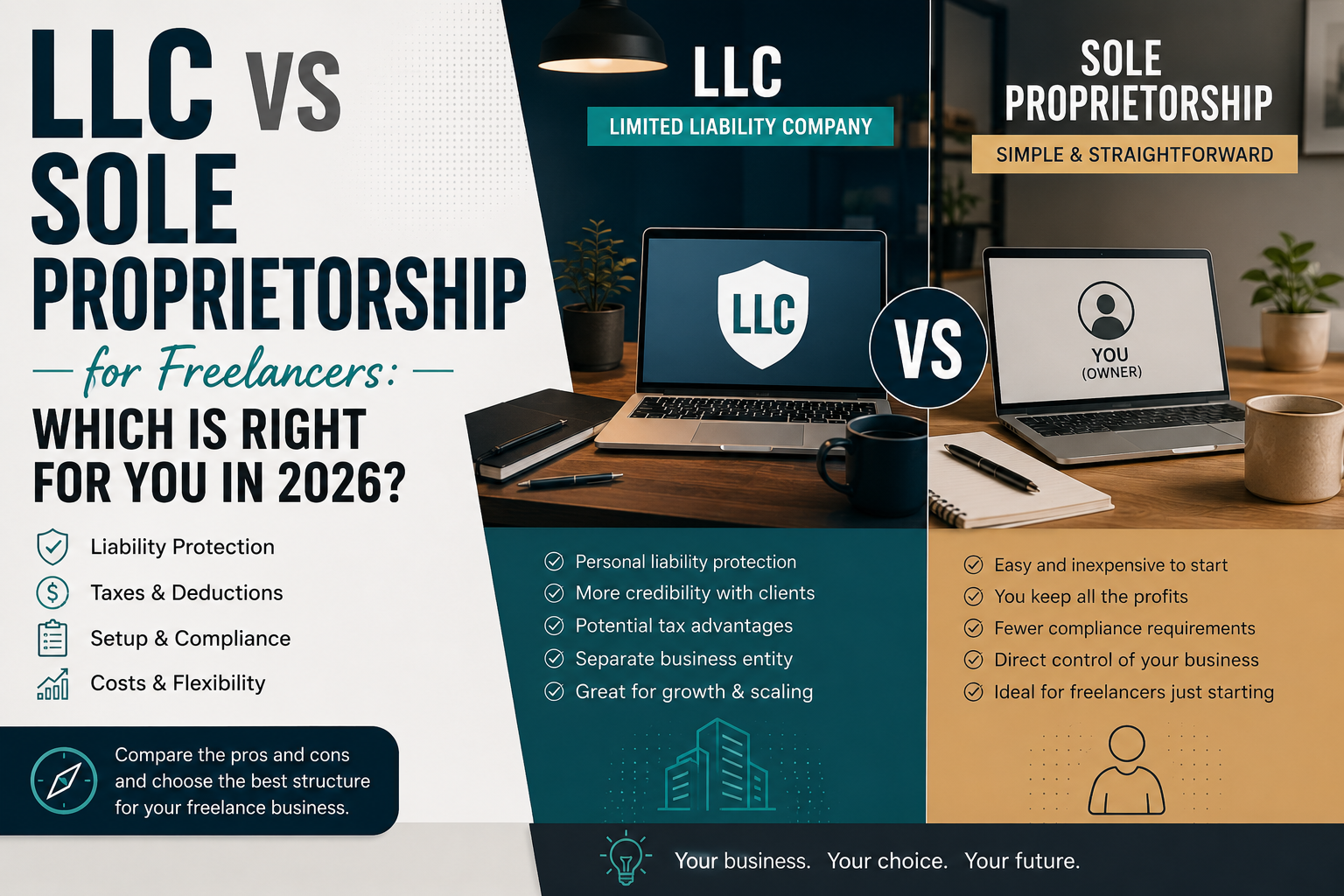
LLC vs Sole Proprietorship for Freelancers: Which Is Right for You in 2026?
When you start freelancing in the United States, you are automatically a sole proprietor. You do not need to file any paperwork or pay any fees to operate under your own name as a self-employed individual. But many freelancers eventually ask: should I form an LLC? The answer depends on your specific situation, income level, and risk tolerance.
This guide breaks down the key differences between operating as a sole proprietor and forming a single-member LLC, so you can make an informed decision.
What Is a Sole Proprietorship?
A sole proprietorship is the simplest and most common business structure in the United States. There is no formal registration required at the federal level. You report your business income and expenses on Schedule C of your personal tax return. Your business and personal finances are legally the same — there is no separation between you and your business.
The main advantages are simplicity and zero cost to set up. The main disadvantage is unlimited personal liability: if your business is sued or incurs debts, your personal assets (home, savings, car) are at risk.
What Is a Single-Member LLC?
A Limited Liability Company is a legal entity that separates your business from your personal life. It provides a liability shield, meaning that in most circumstances, a creditor or lawsuit can only go after the assets of the LLC, not your personal assets.
A single-member LLC is treated as a disregarded entity for federal tax purposes by default, meaning the IRS taxes it exactly like a sole proprietorship — you still report income and expenses on Schedule C. You can also elect to have your LLC taxed as an S-Corporation, which can offer significant self-employment tax savings at higher income levels.
The Liability Protection Argument
The most cited reason for forming an LLC is liability protection. If a client sues you for a project gone wrong, or if you accidentally cause damage while performing your services, an LLC can protect your personal assets. However, this protection has important limits.
An LLC will not protect you from your own negligence or professional misconduct. Courts can also pierce the corporate veil — meaning they can hold you personally liable — if you do not maintain proper separation between personal and business finances. This means you must have a separate business bank account, avoid mixing personal and business expenses, and follow your state’s LLC maintenance requirements.
→ Best Bank Accounts for Freelancers in the US
Tax Implications: Sole Proprietorship vs LLC
For tax purposes, a default single-member LLC and a sole proprietorship are identical. Both report income on Schedule C and pay the same self-employment tax rate. The difference comes if you elect S-Corporation taxation for your LLC.
With an S-Corp election, you pay yourself a reasonable salary and take the remaining profit as distributions. Self-employment tax only applies to the salary, not the distributions. At $80,000 in net profit, for example, this strategy could save $5,000 to $8,000 per year in self-employment taxes. However, S-Corp elections come with additional costs — payroll taxes, quarterly payroll filing requirements, and potentially higher accounting fees.
→ What Is Self-Employment Tax and How to Calculate It
Cost of Forming and Maintaining an LLC
LLC costs vary by state. Filing fees range from $50 in states like Kentucky and Arkansas to $500 or more in Massachusetts. Many states also charge annual fees or minimum franchise taxes. California, for example, charges a minimum $800 annual LLC tax regardless of income. Check your state’s Secretary of State website for current fees.
When Should a Freelancer Form an LLC?
Consider forming an LLC if:
- Your freelance work involves client-facing liability (consulting, design, writing for publication, legal or financial advice)
- You are earning $50,000 or more per year and want to explore the S-Corp tax strategy
- Your clients prefer working with a registered business entity
- You want to build a professional brand identity separate from your personal name
You may not need an LLC if:
- You are just starting out and your income is modest
- Your work carries minimal liability risk
- You live in a state with high LLC fees relative to your income
Professional Liability Insurance vs LLC
An LLC is not a substitute for professional liability insurance (also called errors and omissions insurance). An LLC limits your personal liability from business debts and lawsuits, but professional liability insurance specifically covers claims that your work caused harm or financial loss to a client. Many freelancers benefit from having both.
Steps to Form an LLC
- Choose a name that complies with your state’s naming rules
- File Articles of Organization with your state’s Secretary of State
- Pay the state filing fee
- Obtain an EIN (Employer Identification Number) from the IRS — free and immediate online
- Open a dedicated business bank account
- Draft an Operating Agreement (required in some states, recommended in all)
- Check if your state requires an annual report or franchise tax
→ Best Bank Accounts for Freelancers → Complete Freelance Finance Guide